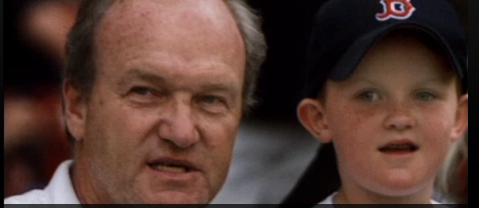
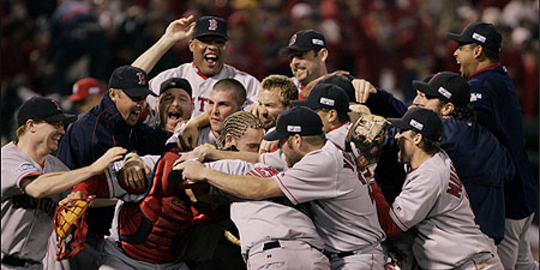
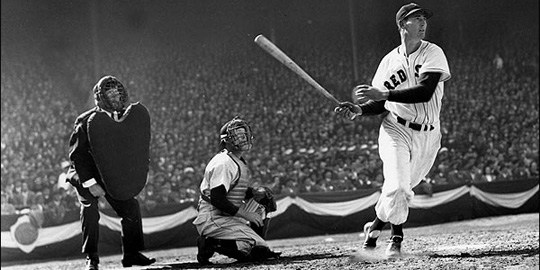
Mike Barnicle talks about the Red Sox loss of 2003 to the Yankees and how it impacted his son, Tim. “The Tenth Inning,” is a two-part, four-hour documentary film directed by Ken Burns and Lynn Novick that premieres this week, September 28 & 29th at 8pm ET on PBS. A new chapter in Burns’s landmark 1994 series, “Baseball,” “The Tenth Inning” tells the tumultuous story of the national pastime from the 1990s to the present day.
David Barron of the Houston Chronicle calls Barnicle’s contribution to the film “perhaps the most valuable addition… (Barnicle) provokes simultaneous laughter and tears on the burden of passing his love of the Red Sox to a second generation….”
“The tale of the Sox bookend years of failure and triumph are given a personal connective thread by former Globe columnist Mike Barnicle, who frames the story through the eyes of his children and his late mother, who, Barnicle recalls, used to sit on a porch in Fitchburg, Mass., her nylons rolled down, listening to the Sox on the radio and keeping score on a sheet of paper.” — Gordon Edes for ESPN.com
Watch here: https://video.pbs.org/video/1596452376/#


![]()
Mike Barnicle: The Case For Ed Rendell as Chief of Staff
Here he was early the other morning in Washington, Ed Rendell, the governor of Pennsylvania, 66 years old, in work-out clothes that made him look like he had stolen a tee-shirt and shorts from a locker at a homeless shelter. He wore a long-sleeved lime green Nike shirt, baggy shorts, a smile on his face and had a plastic take-out tray filled with pastries in his hands.
“Want one?” he asked. “The blueberry muffin looks good.”
He was there to participate in a televised walk-for-health organized by Mika Brezenski and MSNBC’s Morning Joe program. He was on the Mall, half way between the Washington Monument and Capitol Hill; the White House, a mile away, separated from Rendell by the distance between the different universe that has slowly but surely made Barack Obama’s many talents seem lost in a faculty lounge where tenure means nobody ever worries about a paycheck rather than on streets and suburbs where fear stalks the economic landscape causing parents to wonder and worry over prospects of a paycheck for them and a better life for their children down the line, beyond the horizon of November elections.
“What are you going to do next?” Rendell was asked.
“I’m not sure,” he replied.
He has a voice that resembles five miles of gravel road and a resume that has kept him in touch with the daily aggravations and achievements of a disappointed and angry public. He has been a District Attorney, mayor of Philadelphia and is now Pennsylvania’s term limited governor, about to hit the bricks when January arrives. He knows one thing for sure: There is no ideology in items like paving contracts and cops on the block. In those jobs, you either govern and get-it-done or you are gone.
Rendell has been out in the middle of the night at curbside homicides, slashed municipal and state budgets, balanced them too, cried with victims of violence, heard parochial complaints of state legislators, endorsed a losing candidate for president, dropped 40 pounds on a diet but never lost the ability to listen and count, to cut a deal and losses too.
“What about taking Rahm’s job?” he was asked. “That’ll never happen,” he said with a laugh.
It seems nearly certain now that Rahm Emanuel will soon leave as White House Chief of Staff to chase a dream he’s lived with for a long time: Be the next Mayor of Chicago, his home town.
When – and if – that happens, a guy like Rendell would be a gift to a presidency that sometimes seems more intent on lecturing rather than leading. Life is not a seminar to politicians, like governors and mayors, who make multiple decisions daily that ripple through states and cities with immediate impact.
Afghanistan and Iraq are literally about life and death with only a noble few, the military and their families, serving and suffering. A health care bill’s benefits are off on the horizon. A reform of bank regulations has left an entire industry – the financial services industry – uncertain about what new rules will mean so loaning and hiring are both on hold.
Obama’s accomplishments sit in the land like a gift marked “Do Not Open Till 2013.” Too late and too undefined for a country burdened by a lack of confidence in the future and an unhealthy fear of a present where politics careens crazily like a pinball, rebounding between the unearned anger of the Tea Party and the often clueless behavior of Democrats more afraid of losing an election than winning the confidence of people by telling the truth of our history: Any country that has endured depression, world wars, the social and military scar of Vietnam, the cultural disgrace of segregation, the slow, painful loss of industry overseas and Jimmy Carter can certainly deal with carving a new trail in this, a new century.
America needs a pep talk. And Barack Obama needs someone around him who has an instinct for what it feels like when you fear a mail delivery that contains a tuition bill, a phone call from a collection agency, empty spaces in the company parking lot, testimony to lay-offs and a calendar on the wall where the next page turned might as well have a question mark rather than a month.
Ed Rendell won’t be moving into the West Wing when he leaves office. But someone like him, someone who understands that life is often uneven and unfair but that we are all residents of a land rooted in optimism would be a huge benefit for a presidency that seems to have forgotten the flag they planted in the fall of 2008, the one that read, “Follow Me.”
“Way Too Early” airs weekdays on MSNBC from 5:30-6:00 AM
Sunday, Jan. 17, 2010
In Massachusetts, Scott Brown Rides a Political Perfect Storm
By MIKE BARNICLE
Scott Brown, wearing a dark suit, blue shirt and red stripe tie in the mild winter air, stood a few yards in front of a statue of Paul Revere and directly across the street from St. Stephen’s Church, where Rose Kennedy’s funeral Mass was celebrated in 1995, telling about 200 gleeful voters that they had a chance to rearrange a political universe. The crowd spilled across the sidewalk onto the narrow street that cuts through the heart of the city’s North End, the local cannoli capital, located in Ward 3 that Barack Obama carried 2 to 1 just 15 months ago.
” ‘Scuse me,” Joanne Prevost said to a man who had two “Scott Brown for Senate” signs tucked under his left arm. “Can I have one of those signs? I’ll put it in my window. My office is right there.”
She turned and pointed across the street to a storefront with the words ‘Anzalone Realty’ stenciled on window. “Everybody will see it.” (See the top 10 political defections.)
Read the rest of the article at: https://www.time.com/time/politics/article/0,8599,1954366,00.html?xid=rss-topstories
Talks to Lesley Stahl from “60 Minutes”
Stay tuned for more Barnicle on “Morning Joe” ….
Wednesday, December 9, 2009
The Afghan War Through a Marine Mother’s Eyes
By Mike Barnicle
Nearly everything is a sad a sad reminder for Mélida Arredondo: the news on TV, stories in the paper, speeches of Barack Obama and others who talk about a war that seems to have lasted so long and affected so many lives, those lost as well as those left behind.
“Did your son like the Marine Corps?” I ask her.
“Yes,” she replies. “He loved it.”
“And why did he join?”
“Too poor to go to college,” Mélida Arredondo says.
Alexander Arredondo enlisted at 17 and was killed at 20 in Najaf during his second deployment in Iraq. He died on his father’s birthday, Aug. 25, 2004, when Carlos Arredondo turned 44.
“My husband almost killed himself in grief,” his wife says. “The day [the Marines] came to tell us Alex was dead, he poured gasoline all over himself and all over the inside of [their] car and lit it on fire. He survived … physically.”
Read the rest of Mike’s column at Time.com
Mélida Arredondo, of Roslindale, Mass., center, holds boots worn by her son, Marine Lance Corporal Alexander Arredondo, who was killed in Iraq in 2004, as she joins demonstrators in Boston Dec. 2 in opposition to President Obama’s plan to commit an additional 30,000 troops to the war in Afghanistan. Josh Reynolds / AP 
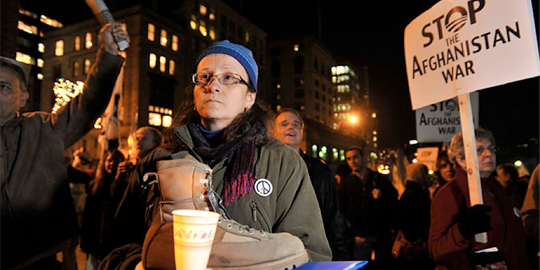
Nearly everything is a sad reminder for Mélida Arredondo: the news on TV, stories in the paper, speeches of Barack Obama and others who talk about a war that seems to have lasted so long and affected so many lives, those lost as well as those left behind.
“Did your son like the Marine Corps?” I ask her.
“Yes,” she replies. “He loved it.”
“And why did he join?”
“Too poor to go to college,” Mélida Arredondo says.
Alexander Arredondo enlisted at 17 and was killed at 20 in Najaf during his second deployment in Iraq. He died on his father’s birthday, Aug. 25, 2004, when Carlos Arredondo turned 44.
“My husband almost killed himself in grief,” his wife says. “The day [the Marines] came to tell us Alex was dead, he poured gasoline all over himself and all over the inside of [their] car and lit it on fire. He survived … physically.”
Last week, she and her husband went to the Kennedy Library in Boston to hear Ted Kennedy’s widow talk about her husband’s book, True Compass. She and Carlos, born in Costa Rica, stood patiently while Vicki Kennedy signed books and shook hands. They reminded her that their son Alex and her husband the Senator died on the same day, Carlos’ birthday, five years apart, and they thanked her for the help Senator Kennedy provided after the young Marine’s death when his father sought citizenship.
“I remember,” Vicki Kennedy told them.
The library event took place hours after Obama announced he would throw 30,000 additional troops into an ungovernable country called Afghanistan. Carlos and Mélida Arredondo listened and thought of their lost son and a nephew now at Fort Hood, one tour of Afghanistan behind him, a second on the horizon because the Army is fractured by years of battle.
“People have no idea what it does to families,” she says. “When he got killed, I didn’t sleep for days. I still don’t sleep. I lost 30 pounds. My husband withdrew from everyone.
“My son Brian, he is 22, and he can’t seem to do anything without thinking about Alex. We are very worried about him.”
The families of the fallen are nearly alone in a nation served by an all-volunteer military now nearing a decade on the front line against an enemy that wears no uniform and cannot be brought to any negotiating table. The pain of loss is forever. Their shared grief scatters across the land like ashes blown by the wind, invisible to the majority preoccupied with joblessness and a gnawing anxiety that America might be broken.
“I was disappointed in Obama,” Mélida Arredondo says. “I thought, ‘I’ve heard this before, from Bush.’ He wasn’t as passionate as he usually is. He sounded like a professor. I want to hear him talk about the cost of these wars. I want a discourse about a war tax. I want people to have some skin in the game.”
“Did you believe him?” I ask.
“Wrong question,” she suggests. “Did he believe his own speech? I don’t think so.”
She speaks from another battleground too, the health care wars that threaten to swallow Washington. For nine years, Mélida Arredondo has worked at a neighborhood health center in the Dorchester section of Boston, the Upham’s Corner Health Center. She has a master’s in public health and does the work of three people because of staff layoffs and funding cutbacks.
“We take care of the poor,” she points out. “We had 250,000 patient visits last year in this one clinic. We’ll have even more this year. We have staff people who speak Vietnamese, Spanish, Haitian Creole, Portuguese and English. Many of the people we see are uninsured. The costs are enormous. That’s why I’m a fiscal conservative. Working here, I have to be.”
She is behind a desk on the second floor of a three-story brick building located on a busy boulevard filled with those who measure the future by a wristwatch. She is surrounded by the heartache of those who show up grappling with the oldest of maladies: no money. The work helps push her own sadness, etched permanently in her eyes, off the screen for a few hours each day.
Two days ago, returning home in darkness, she discovered a letter from the President. She and her husband had written twice to the White House, upset about the prospect of increased casualties.
“Thank you for writing me,” Barack Obama wrote. “Every day, we are humbled by the legacy of our men and women in uniform who sacrificed their lives for our country.”
Mélida Arredondo paused after that first paragraph. She thought of Alex and her husband Carlos and her nephew at Fort Hood. She thought about the long parade of the poor who arrive each day at her work seeking care, and she thought about the fact that she was a member of a Gold Star family.
“Wars cost a lot,” she says.
Hotline On Call/National Journal
By Rachelle Douillard-Prouix
During this morning’s broadcast of “Morning Joe,” MSNBC’s Willie Geist had a (lighthearted) bone to pick with Mike Barnicle over sarcastic comments the latter made during the show’s Wednesday broadcast. To highlight the annual lighting of the Christmas tree in Rockefeller Center that took place last night, Geist reported live from the courtyard.
Barnicle, following Geist’s report from in front of the hulking tree: “I finally realized what I want for Christmas, Willie. I would like to see that tree fall right on you right now.”
Geist reported this morning on the show that he had received many emails regarding Barnicle’s comments, and demanded an apology.
Geist: “He said he wanted the tree to fall on me. I’ve received a number of emails, including from members of my own family, attacking Mike Barnicle.
Mike Barnicle, what say you, sir?”
Barnicle, reading from newspaper coverage of the statement golfer Tiger Woods released in light of his own recent controversy: “Willie, and all of you people out there, let me just say, I have let my family down, and I regret those transgressions with all my heart. I have not been true to my values in that statement yesterday.”
Continued Barnicle: “And I’m far short of perfect. I am dealing with my behavior, and personal failings, behind closed doors with Willie and my family. So, I beg your forgiveness.”
Geist: “I forgive you for your personal failings. Thank you, Mike Barnicle. Apology accepted.”

*NEW* True Compass: The Life of Senator Edward M. Kennedy
THURSDAY, DECEMBER 3, 2009 6:00-7:30 PM
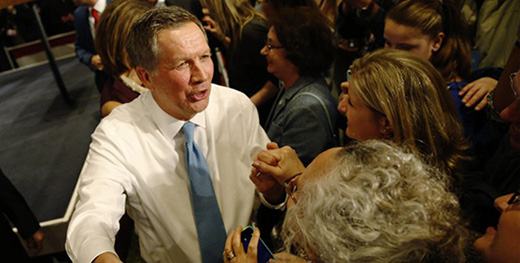
Victoria Reggie Kennedy introduces historians Doris Kearns Goodwin, Michael Beschloss and Washington Post columnist E.J. Dionne, who will discuss Senator Kennedy’s memoir, True Compass, his role in history and his legacy with political analyst, Mike Barnicle.
Seating is limited, first come, first served.
Friday, Oct. 16, 2009
One Death in Afghanistan: Ben Sklaver’s Story
Last week, Laura and Gary Sklaver buried their oldest boy, Ben, who was 32 when killed by a suicide bomber in the remote village of Murcheh in the distant land of Afghanistan. Ben was a captain in the United States Army. Now he has become one of 804 Americans, 37 from Connecticut, to lose their lives in an expanding war that belongs mostly to the parents and families of those who serve a nation preoccupied by a wounded economy and political polarization.
“He didn’t have to go,” Laura Sklaver said the other day. “His obligation was up in May.”
“But he was recalled in March,” Gary Sklaver added. “And he didn’t want to leave his men.”
Ben Sklaver grew up drawn to service. He admired his grandfather who served with Patton’s Army in World War II. He joined ROTC at Tufts, received a Master’s in international relations from the Fletcher School of Diplomacy, was commissioned as an officer in the Army Reserve in 2003 and became convinced that a world consumed with conflict and terror might be changed by Americans bringing clean water, medicine and food as much as by drones, missiles and military might.
10/06/09: Barnicle talks with Jim Braude and Margery Eegan about jury duty and health care reform.
Listen here: https://barnicle.969fmtalk.mobi/2009/10/06/100609-jury-dutyhealthcare-reform.aspx
“Barnicle’s View”, with Mike Barnicle, Imus in the Morning, Monday-Wednesday-Friday, 6:55a & 8:55a.
10/05/09: Barnicle talks with Jim Braude and Margery Eegan about David Letterman admitting to having affairs with women who worked for him and the situation in Afghanistan.
Listen here: https://barnicle.969fmtalk.mobi/2009/10/05/10509-david-letterman-affairsafghanistan.aspx
“Barnicle’s View”, with Mike Barnicle, Imus in the Morning, Monday-Wednesday-Friday, 6:55a & 8:55a.
09/25/09: Barnicle on the war in Afghanistan.
Listen here: https://barnicle.969fmtalk.mobi/2009/09/25/92509-afghanistan.aspx
“Barnicle’s View”, with Mike Barnicle, Imus in the Morning, Monday-Wednesday-Friday, 6:55a & 8:55a.
09/21/09: Barnicle has a word to say about how technology is affecting the art of letter writing and penmanship being taught in schools today.
Listen here: https://barnicle.969fmtalk.mobi/2009/09/21/92109-writingpenmanship.aspx
“Barnicle’s View”, with Mike Barnicle, Imus in the Morning, Monday-Wednesday-Friday, 6:55a & 8:55a.
09/18/09: Barnicle talks about Jared Monti receiving the Medal of Honor yesterday.
Listen here: https://barnicle.969fmtalk.mobi/2009/09/18/91809-jared-montimedal-of-honor.aspx
“Barnicle’s View”, with Mike Barnicle, Imus in the Morning, Monday-Wednesday-Friday, 6:55a & 8:55a.
9/11/09: Barnicle remembers September 11, 2001, specifically focusing on how we all felt the next day when we were one people united against a common foe.
Listen here: https://barnicle.969fmtalk.mobi/2009/09/11/91109-remembering-911.aspx
“Barnicle’s View”, with Mike Barnicle, Imus in the Morning, Monday-Wednesday-Friday, 6:55a & 8:55a.
8/31/09: Barnicle talks about the life of Michael Davey, a 34-year-old police officer, war veteran, husband and father cut short after he was struck by a 79-year-old driver last week.
Listen here: https://barnicle.969fmtalk.mobi/2009/08/31/83109-michael-davey.aspx
“Barnicle’s View”, with Mike Barnicle, Imus in the Morning, Monday-Wednesday-Friday, 6:55a & 8:55a.